City: A Guidebook for the Armchair Traveller
03 August 2010 | City | 11 comments
Writing a book is a solitary process. For months and often years, the book only exists in the writer’s mind. Sometimes, as you write, that book can seem like a mirage on the horizon, its form shimmering and changing before your eyes. Believe me, it’s disconcerting. But you press on.
Over time, as the words flow and the pages increase, the book takes shape and becomes more substantial, more real. But for me the book doesn’t really come alive until it has a cover. I’ve been working on my current book — a history of cities — for about three years now. It’s more or less written, although there are still a few straggling, wayward sections to finish.
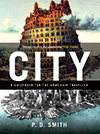
And now it has a cover. My editor at Bloomsbury Publishing emailed it to me a day or so ago. I’m very pleased with it. In fact, I think it’s rather wonderful.

Pre-order at Amazon.co.uk | Amazon.com

Gaia | 12 August 2010
Beautiful cover. Reminds me of the prints of an artist I like called Martin Langford http://www.martinlangford.com/artwork.php?category=Environment
PD Smith | 12 August 2010
Thanks! And for the link to Langford’s work — it’s new to me…
Nick Harkaway | 13 August 2010
Gorgeous! Nice one…
PD Smith | 13 August 2010
Cheers Nick!
Mark Tebeau | 15 August 2010
Congrats and great cover!
I pre-ordered!
Sorry that I missed you when I was in London.
best
Mark
PD Smith | 15 August 2010
Glad you like it! Catch you next time…
Thomas | 30 August 2010
My congratulations! The cover looks very good and I am very curious to read it (as usual with interesting books I suggest the university library to buy it).
PD Smith | 30 August 2010
Glad you like it, Thomas — and thanks for all your helpful links!
Thomas | 01 September 2010
A few more links: This press report today tells about Brasilian Favela’s becoming official tourist attractions, after receiving some criminalistic cosmetics. By accident, we just visited a city in Germany with a similar change some time ago: What is now the fashionable inner city of Luebeck, between the early middle ages and early modern age “New York of the Baltic Sea” now better known through Thomas Mann’s novel, was until ca. 100 years the gruesome quarter of the extremly poor. Some fotos (the painings are from Armin Müller-Stahl who lives there, the texts at the end from some digging in the Thomas Mann archive on one of his former classmates)
“Asymmetriad” refers to something in Stanislav Lem’s “Solaris”, taken as analogy to the sudden explosion of culture in the Weimar republic and it’s gruesome end:
“(Visiting a museum on the strange planet,) One plump schoolgirl (she looked about fifteen, peering inquisitively over her spectacles) abruptly asked: “And what is it for?”
In the ensuing embarrassed silence, the school mistress was content to dart a reproving look at her wayward pupil. Among the Solarists whose job was to act as guides (I was one of them), no one would produce an answer. Each symmetriad is unique, and the developments in its heart are, generally speaking, unpredictable. Sometimes there is no sound. Sometimes the index of refraction increases or diminishes. Sometimes, rhythmic pulsations are accompanied by local changes in gravitation, as if the heart of the symmetriad were beating by gravitating. Sometimes the compasses of the observers spin wildly, and ionized layers spring up and disappear. The catalogue could go on indefinitely. In any case, even if we did ever succeed in solving the riddle of the symmetriads, we would still have to contend with the asymmetriads!
The asymmetriads are born in the same manner as the symmetriads but finish differently, and nothing can be seen of their internal processes except tremors, vibrations and flickering. We do know, however, that the interior houses bewildering operations performed at a speed that defies the laws of physics and which are dubbed ‘giant quantic phenomena.’ The mathematical analogy with certain three-dimensional models of the atom is so unstable and transitory that some commentators dismiss the resemblance as of secondary importance, if not purely accidental. The asymmetriads have a very short life-span of fifteen to twenty minutes, and their death is even more appalling than that of the symmetriads: with the howling gale that screams through its fabric, a thick fluid gushes out (from the planet below), gurgles hideously, and submerges everything beneath a foul, bubbling foam. Then an explosion, coinciding with a muddy eruption, hurls up a spout of debris which rains slowly down into the seething ocean. This debris is sometimes found scores of miles from the focus of the explosion, dried up, yellow and flattened, like flakes of cartilage.”
PD Smith | 02 September 2010
Ah, Buddenbrooks — one of my favourite novels…
PD Smith. « from the desk of… | 26 November 2010
[…] When will we see your fiction? Now, that’s an unexpected question! Actually, I have been writing a novel. I guess you could call it a kind of urban fantasy. Writing fiction takes you to a different place entirely from non-fiction – a stranger, darker place. But I’m not very good at switching between fiction and non-fiction projects, so I’ve had to put the novel aside for now while I write City: A Guidebook for the Armchair Traveller. […]