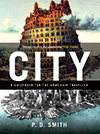
The City and the World, by Gregor Hens
11 May 2025 | architecture, China, cities, Cologne, German culture, Gregor Hens, Los Angeles, psychogeography, skyscrapers, urban planning | Post a comment
I’ve very much enjoyed reading The City and the World by Gregor Hens, beautifully translated from German by Jen Calleja.
In this book, Hens is fascinated by “the human being in their urban context, the human among humans, one among many in the environment he has created for himself”. Blending reportage with memoir, dreams and theoretical writings on cities, he takes the reader on a memorable journey through the life-world of Homo urbanus.
From the “gigantic miniature park” in Shenzhen, China, 48 hectares of scale models of the urban wonders of the world (“there’s nowhere better to daydream being Icarus than in a miniature wonderland”), to Los Angeles, which he first visited at the age of 16, before Google Maps existed (“I had no other choice but to open myself up to the city with all my senses, my nose, eyes and ears”), this is a wonderfully evocative account of the urban experience in the 21st century.
An author and translator who now teaches urban studies and creative writing in “the winter-grey city of Berlin”, Hens grew up on the outskirts of Cologne. He recalls often climbing an old oak (“the Cologne Tree”) from which he could see the iconic twin towers of the city’s cathedral soaring above the city’s skyline. He points out that the grid of a Roman military camp still defines the structure of inner-city Cologne. The other city in which he lived for many years, LA, was also based on a grid. In a book about experiences, such parallels are key to shaping how we see a city.
In Berlin, he tasks his international students with going to an “underground stop that is phonetically closest to your name or your hometown”, and walking south-southwest to the next station: “Don’t use your mobile phone. Be sure to ask for directions. Describe what you see and experience.” He notes that they end up wandering around the city “lacking any and all orientation”. Nevertheless, he speculates about how the experiment may have changed their view of the city, “because the person walking carries what resonated within them into urban spaces…we can still feel the vibrations in the matrix of the city long after we no longer hear them”.
Infused with the spirit of psychogeography, Hens’s impressionistic book reveals how the city opens itself up to walkers: “the city is moving; there are places where people move in streams. The psychogeographer stands still; their activity is to watch.” Though he acknowledges that the vastness and internal speed of the modern metropolis is no longer conducive to this: it’s a maelstrom that prevents one from seeing anything other than what is immediately in front of you. Shanghai has become the ultimate symbol of such urban modernity, the result of a “ruthless and destructive” futurism. It is a dystopian city, but “Shanghai is the future”, he says bleakly.
Filled with allusions to the literature and art of the city, this is a delightfully original and creative celebration of how we experience modern urban spaces through our senses, memory, ideas and images. It’s published this month by Fitzcarraldo Editions and is well worth reading!