Losing myself in Tokyo
I’ve just returned after a holiday in Japan. It was my first time there. We stayed in Tokyo and Kyoto, with a few days in the mountains of Hakone. As I write, my brain keeps telling me it’s the middle of the night. I’m dog-tired but my mind is also buzzing with the sights and sounds of Japanese cities.
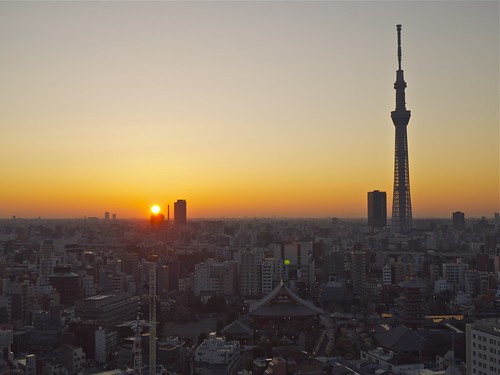
In the sixteenth century, Tokyo was little more than a small town. Now it’s the largest metropolis on the planet, with some 33 million people living in the metropolitan region. That’s about the same number as live in the whole of Canada.
Tokyo’s city plan has always been somewhat chaotic. Its earliest planners wanted to create an urban labyrinth in which invading armies would become confused and easily defeated. They did a good job. It still has the same effect on modern visitors. But some say getting lost is the only way to really get to know a city.
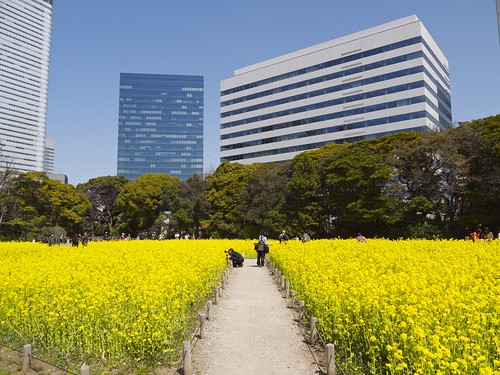
In my wanderings through this immense urban labyrinth, I came across a dazzling oilseed rape field in the Hama-Rikyu Garden that looked as though it had been plucked from rural Hampshire and dropped into the heart of high-rise Tokyo.
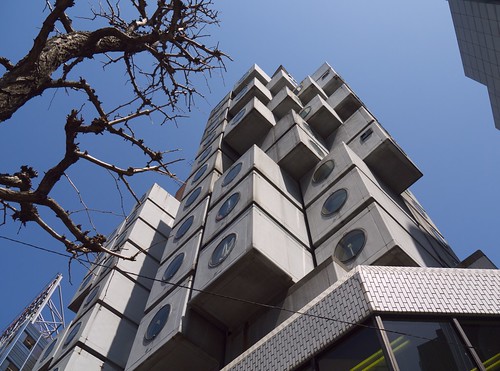
Nearby stands the Nakagin Capsule Tower, built in 1972. It was designed by architect Kisho Kurokawa so that additional accommodation pods could be added to the building as and when they were needed. Sadly, this wonderfully futuristic building now looks neglected and may be demolished.
To try to get a sense of the scale of this megalopolis I went up to the observation deck on the 45th floor of the Tokyo Metropolitan Government Building. This rather ugly structure was completed at the end of the boom years of the 1980s. Now in the streets behind it there are homeless men sleeping on the pavements. From its windows you can see the city stretching out in all directions like an endless concrete carpet. It’s an astonishing sight, one I won’t forget.
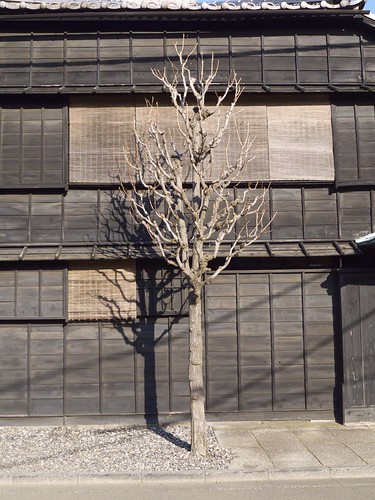
In this vast metropolis the intimacy of the winding streets around Shinobazu-Dori in Yanaka are a reminder of the human scale of a city that often seems anonymous and homogenous, as in the soulless, wide avenues and glitzy shops of Ginza.
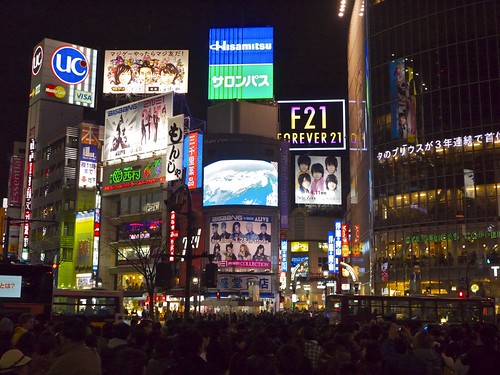
At night, there’s an extraordinary energy in Shibuya. The city comes alive here. The crowds in the packed streets of this Times Square of the East bathe in the artificial light of electronic advertising signs and giant video screens. It’s a constantly shifting sea of people. I was surprised, not to say shocked, to come face to face with Jedward at the Shibuya crossing. But I tried not to let it spoil my holiday.
On the other side of the city, traditional paper lanterns cast a more gentle light on the blood-red Senso-ji Temple in Asakusa, Tokyo’s oldest Buddhist temple.

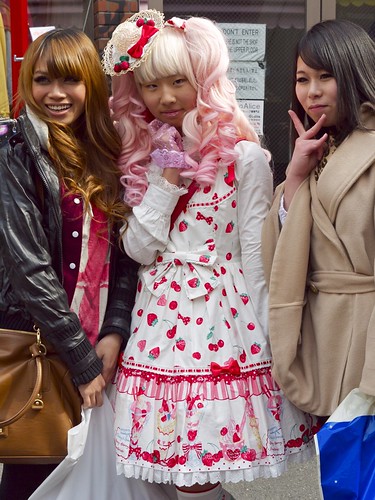
As in all great cities, Tokyo is rich with contrasts. At the weekend in Harajuku we saw cosplay queens posing with tourists while at the nearby Meiji Shrine, a traditional Shinto wedding procession moved silently through the temple watched by curious foreigners and the faithful alike. Past and present worlds coexist in the same time and space.
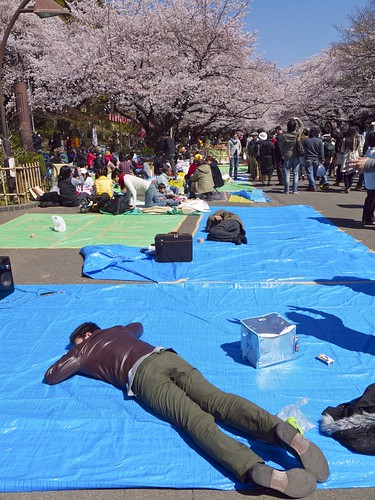
The next morning, to the north of the city in Ueno Park, people were jealously guarding territory they had claimed beneath blossoming cherry trees. For it is April and after a particularly hard winter, that most Japanese of seasons – Spring – has finally arrived and with it the cherry blossom, coating the branches like white and pink snow.
Much of Tokyo’s urban history has been burned, bombed or developed out of existence. It’s a modern city – efficient, clean and too busy to worry about the past. By contrast, Kyoto, which was Japan’s capital city from 794 until 1869, is rich in history. There are more than one and a half thousand temples in this city of 1.6 million people. It also contains some of the most exquisite gardens to be found anywhere on the planet. And unlike Tokyo, the city has a gridiron plan, based on that of Chang’an in China. It’s not easy for either invading armies or foreign tourists to get lost here.
With only a couple of days in the city, I felt obliged to try to see some of the most famous sights. Naturally, these were choked with tourists like myself. But Kyoto is big enough not to feel like a heritage theme park. And its sights did not disappoint. The 1001 ancient wooden statues of Kannon, the Buddhist goddess of mercy, at the Sanjusangen-do temple are astonishing. The Shogun’s Ninomaru palace at Nijo Castle is a beautiful wooden structure with squeaking cedar floors designed to betray the presence of assassins.
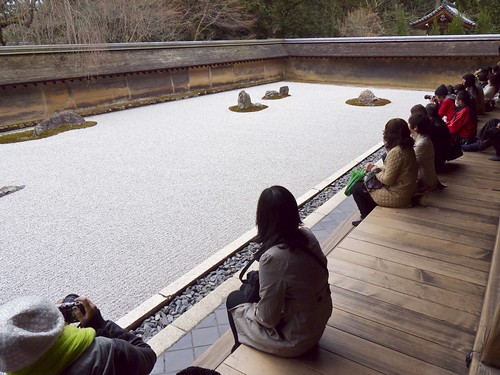
And, of course, there were the gardens – green jewels in a modern, grey city. I saw rain-swept moss gardens with sculpted trees, as well as austere raked gravel gardens, as at Ryoan-ji, which manage somehow to be both empty yet impossibly dense with meaning.
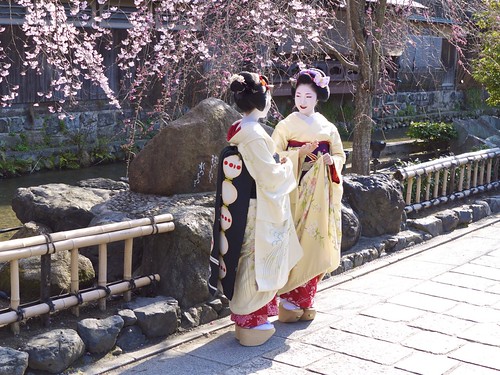
Then, between the spring showers, there were a few hours of glorious warm sunshine, and we came across two maiko (apprentice geishas) beneath the cherry trees of Shimbashi, beside the Shirakawa Canal. It was one of those surprising moments when all one’s expectations of a place are wonderfully fulfilled.
The people of Tokyo and Kyoto are among the friendliest I have met in any city. Stand for a few moments staring blankly at a map, and it won’t be long before someone comes up to you and asks where you want to go. Their streets are spotless and they are clearly immensely proud of their cities. In Harajuku we saw about seventy people, some with children, out early on a Sunday morning, clearing up litter in their neighborhood.
It was just a short visit. I know I only scratched the surface of these great cities. But I came away with some wonderful memories and a sense that there was so much more waiting to be discovered.
You can see more of my photos of Japan on Flickr.