Gentlemen, You are Mad
15 June 2012 | City, CND, cold war, Doomsday Men, Dr Strangelove, H-bomb, nuclear weapons | Post a comment
My essay “Gentlemen, You are Mad!: Mutual Assured Destruction and Cold War Culture” has been published in The Oxford Handbook of Postwar European History, edited by Professor Dan Stone. This substantial volume contains 35 chapters exploring the Cold War through the lenses of many different disciplines. My contribution looks at how mutual assured destruction (MAD) was reflected and refracted in European culture and society from 1950 to 1985, and argues that film and fiction played a key role in highlighting the horrific potential outcome of MAD – a global nuclear holocaust. It was fascinating to revisit a subject I explored in my book Doomsday Men (2007) but I also enjoyed the opportunity to look in more detail at the history of the anti-nuclear movements throughout the Cold War.
The title of the essay is a quotation from a 1946 article by the historian Lewis Mumford attacking the suicidal policies of the Cold War. “We in America,” he wrote, “are living among madmen. Madmen govern our affairs in the name of order and security.” According to Mumford, the modern superweapon society, for all its technological supremacy, was unable to recognize the looming disaster. People were sleepwalking towards the abyss of atomic war: “The madmen have taken it upon themselves to lead us by gradual stages to that final act of madness which will corrupt the face of the earth and blot out the nations of men, possibly put an end to all life on the planet itself.”
Mumford’s article provided the perfect point of departure for a journey through the era of the alphabet bombs – the A‑bomb, the H‑bomb and the world-destroying C‑bomb. I show that films and fictions from Dr Strangelove and On the Beach, to The Day After played a major role in revealing the flawed, doomsday logic behind MAD. As Albert Camus said just days after the bombing of Hiroshima: “peace is the only battle worth waging”.
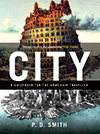
It was another text by Mumford – The City in History (1961) – that was among the first books I read when I began writing my latest book, City: A Guidebook for the Urban Age. Mumford’s book is an immensely impressive work of scholarship and synthesis, although as Jonathan Yardley pointed out in his recent Washington Post review of my book, much has changed since he was writing:
“Half a century ago, Lewis Mumford published The City in History, a hugely influential and in some ways controversial book that has been the Bible for students and lovers of city life. But that was half a century ago, and around the world the cityscape has undergone enormous changes. A new look at this great subject has for some time been needed, and in City: A Guidebook for the Urban Age, P.D. Smith provides it. A British scholar connected to University College London, Smith is less philosophical and more empirical than Mumford, but if anything this is welcome, as City is wholly accessible to the serious general reader.”
 City was published a couple of weeks ago in the UK and is due out on 19 June in US. It is always an anxious time for any author and as City is structurally quite unusual – being designed like a guidebook to an imaginary “Everycity” – I am particularly interested in the reaction of readers. Fortunately Yardley’s review was favourable, as was Jonathan Glancey’s in the Guardian:
“So behind the walls of the city – Smith has a chapter on these – there is darkness, graffiti, street language, uprisings, religions, ghettos and slums, cathedral-like railway stations, traffic, trade, bazaars, malls, museums, red-light districts and so much else. Smith packs the blood, guts, underbelly and driving forces of the archetypal city into chapters as densely packed as the streetscapes of Manhattan or Hong Kong.”
So far I have talked about the book on BBC Radio 3, Talk Radio Europe, as well as National Geographic Radio, and there are many more interviews and articles yet to appear. Watch this space!
Unfortunately, last week I injured my back – what is popularly (although, according to my physiotherapist, inaccurately) known as a slipped disc. It’s excruciatingly painful and I’m writing this while lying flat on my back. It’s terrible timing, of course, but I’m keeping my fingers crossed that the drugs and the doctors will have me on my feet again soon.
It does, however, provide the perfect excuse to catch up on reading, such as Nick Harkaway’s wonderfully doomy novel Angelmaker… Just what the doctor ordered!